The logistics problem of limited venue parking does not announce itself until the week before the wedding, when the venue coordinator mentions that guest parking is “limited to twenty spaces” for an event with ninety guests. At that point, improvised solutions, a text chain asking people to carpool, a hope that the nearby street fills slowly, replace what should have been a planned transport arrangement. The conversation is much easier when it starts at the time of venue booking.
Why does limited parking require a transport plan rather than just a parking workaround?
A parking workaround, overflow on a nearby street, a shuttle from a pub car park a kilometre away, solves the space problem but creates a guest experience problem, particularly for elderly guests, those with mobility limitations, and guests travelling in formal attire. A transport plan, by contrast, removes the parking constraint entirely by replacing private vehicles with coordinated chauffeur transfers. Guests arrive at a designated point, are collected in one of the Marquee Limousines vehicles, and are delivered to the venue door without ever engaging with the parking problem.
The starting point for guest transport planning is the wedding chauffeur service, which covers both the bridal party and broader guest logistics.
How do you identify which guests most need arranged transport?
The guests who most need arranged transport fall into three categories: elderly or mobility-limited guests, interstate and international guests unfamiliar with the area, and guests who will be drinking and should not drive. Most weddings have all three. Prioritising these groups for confirmed vehicle bookings, rather than treating guest transport as an optional add-on, demonstrates consideration and reduces the logistical conversations couples would otherwise have to manage individually with each affected guest.
A practical approach is to include a transport information card with invitations for venues with parking limitations. The card states the pick-up point, the departure times, and a contact number for the transport provider. This converts a potential point of confusion into a clear instruction.
What pick-up structure works best for dispersed wedding guests?
The most manageable pick-up structure for dispersed guests is a hub-and-spoke model: guests make their own way to two or three central pick-up points (a hotel, a train station, a well-known landmark), and chauffeur vehicles operate circuits between those hubs and the venue. Attempting direct collection for forty guests across a wide metropolitan area is operationally impractical and expensive. Hub collection concentrates the logistics, reduces vehicle count, and gives guests a clear instruction rather than a vague promise that “someone will pick you up.” Current visitor and planning information is available from the Destination NSW Hunter Valley guide.
For weddings in semi-rural or regional venues, wineries in the Hunter Valley, heritage estates outside Melbourne, coastal properties in the South West, the hub point is typically the nearest town centre or the accommodation block where most guests are staying.
How many guests can a Mercedes-Benz Sprinter carry for a wedding?
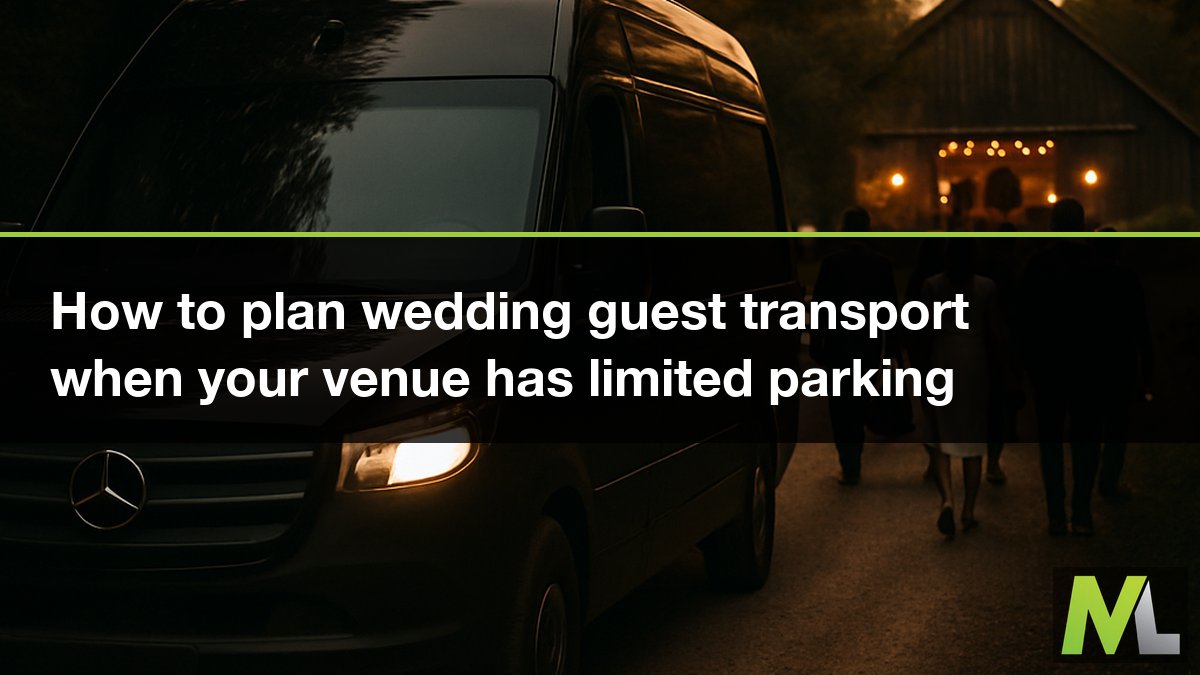
A Mercedes-Benz Sprinter in wedding configuration seats up to eleven passengers, making it the most efficient vehicle for guest group transfers where a single departure from a hub point carries a substantial portion of the guest list. The Mercedes-Benz Sprinter is finished in black, presents formally at the venue entrance, and has sufficient luggage capacity to accommodate overnight bags for guests staying at the venue post-event.
For a ninety-guest wedding with limited parking, a realistic transport structure might involve two Sprinter circuits from the primary hotel hub, with a sedan operating for VIP guests and elderly relatives who require direct transfer service.
What is the standard timing structure for wedding guest transport?
A standard timing structure runs a pre-ceremony departure (typically sixty to ninety minutes before the ceremony start), a post-ceremony transfer to the reception if the locations differ, and a return service at the end of the reception covering one early and one main departure. The return service is where transport plans most commonly unravel, the booking is in place, but guests do not know when or where to board. A clearly communicated boarding time and location, repeated at the reception itself by the MC or a card at each table, ensures the investment in return transport is actually used.
Couples should brief the venue coordinator on the transport plan so the venue team can direct guests to the boarding point at departure time rather than leaving guests to find it themselves.
How do you handle guests who want to leave at different times?
The practical solution is booking two or three scheduled return departures rather than an open-ended “on-demand” service, which is operationally unworkable at scale. A 10:30pm early departure covers guests with young children or early commitments; an 11:30pm or midnight main departure covers the majority; a late-night vehicle handles the final stragglers. Guests choose their departure at RSVP stage or via the transport information card, allowing the vehicle manifest to be confirmed in advance.
Attempting to provide individualised on-demand return for forty guests with a single vehicle is not viable. Scheduled departures with clear communication are more reliable and typically more appreciated.
What should couples communicate to guests about the transport arrangement?
Guests need four pieces of information: the pick-up location, the departure time, what to do if they miss their allocated vehicle, and the return departure schedule. Providing this information twice, once with the invitation and once as a day-of reminder via text or a note at the venue, eliminates the “I didn’t know” problem at boarding time. Marquee Limousines’s contact number should be available to guests in case of real-time changes.
How far in advance should wedding guest transport be booked?
For a vehicle fleet of three or more, booking six to eight weeks before the wedding date is advisable; for peak wedding periods (spring and early summer in most Australian states), twelve weeks provides the best availability. Venues with known parking constraints often see multiple weddings in the same peak period, and demand for Sprinters and multiple-vehicle coordinated bookings concentrates at the same times.
The full range of chauffeur services is available for all elements of the wedding day, from the bridal party transfer to the final guest return circuit.
To begin planning your wedding guest transport, call Marquee Limousines Limousines on 1300 846 008.
Why choose Marquee Limousines for wedding transport?
Marquee Limousines provides wedding transport on an hourly basis with a dedicated chauffeur and vehicle for the duration of the booking, not a rushed point-to-point transfer between other jobs. The fleet includes black Mercedes S-Class and BMW 7 Series sedans for the couple, and the Mercedes V-Class for bridal parties of up to 7 passengers. Every vehicle is presented with bottled water and USB phone charging as standard. The evening before the wedding, Marquee sends an SMS with the chauffeur’s direct contact number, giving the bridal party a confirmed point of contact on the day. Call 1300 846 008 or request a quote online to plan your wedding transport with Marquee Limousines.