Conference logistics is a field defined by its margins: the difference between a smooth delegate experience and a chaotic one is often measured in minutes and metres. Getting 200 people from an airport to a convention centre, managing VIP speakers who arrive on different flights from different cities, and ensuring that the CEO’s car is waiting three minutes before the welcome dinner begins, these are not abstract challenges. They require ground transport operators who understand the intersection of time, volume, and expectation, and who can execute reliably across multiple days of complex scheduling.
What does a professional conference transport brief typically include?
A well-prepared conference transport brief covers delegate arrival and departure windows, VIP schedules, hotel block locations, venue addresses, any off-site dinner or activity transfers, and contact details for the event manager and the on-site logistics coordinator. Transport providers who receive a complete brief can build a vehicle schedule that anticipates bottlenecks rather than reacting to them. The most common gap in briefs is incomplete flight information for VIP speakers, when the transport operator doesn’t have a flight number, they can’t monitor for delays, which cascades into delayed pickups at the airport.
A dedicated corporate chauffeur assigned to a VIP speaker or keynote panellist provides a consistent point of contact for that individual throughout the conference, the same driver, the same vehicle, the same briefing every morning.
How are airport-to-hotel transfers handled for large delegate groups?
Large delegate arrivals are typically managed in cohorts: vehicles are allocated based on flight arrival windows, with each vehicle assigned to a specific group or hotel destination, and a ground coordinator monitors the arrivals hall to direct passengers to the correct vehicle. For a conference with 300 delegates arriving across a six-hour window on the day before the event, this means a rolling schedule of vehicles, not a single fleet deployment. The logistics resemble an airport shuttle operation, but without the shared-route stops: each vehicle goes directly to the delegate’s hotel.
Attempting this with ad hoc rideshare bookings creates coordination failures, missed pickups, and delegates who arrive at the wrong hotel. Pre-booked, scheduled transfers with a confirmed vehicle per group eliminate those failure points.
How does transport work for VIP speakers and executives?
VIP speakers typically receive individual vehicle allocations with a named driver, a pre-confirmed pickup time, and a confirmed meeting arrangement at the airport arrivals hall, the same protocol used for executive airport transfers, applied to the conference context. For high-profile speakers travelling from overseas, the pre-trip SMS the evening before is particularly valued: it provides a local contact number, confirms the vehicle, and removes the cognitive load of navigating an unfamiliar city after a long flight. Current visitor and planning information is available from the Tourism Queensland Brisbane guide.
Marquee Limousines coordinates corporate transport across 8 Australian cities, with 24/7 operations and account invoicing available for approved clients.
For multi-city roadshows where the same executive is presenting across Sydney, Melbourne, and Brisbane within a single week, a roadshow chauffeur arrangement provides a consistent service standard across all cities, with coordination managed centrally rather than separately in each market.
What vehicles are used for conference transport in Australia?
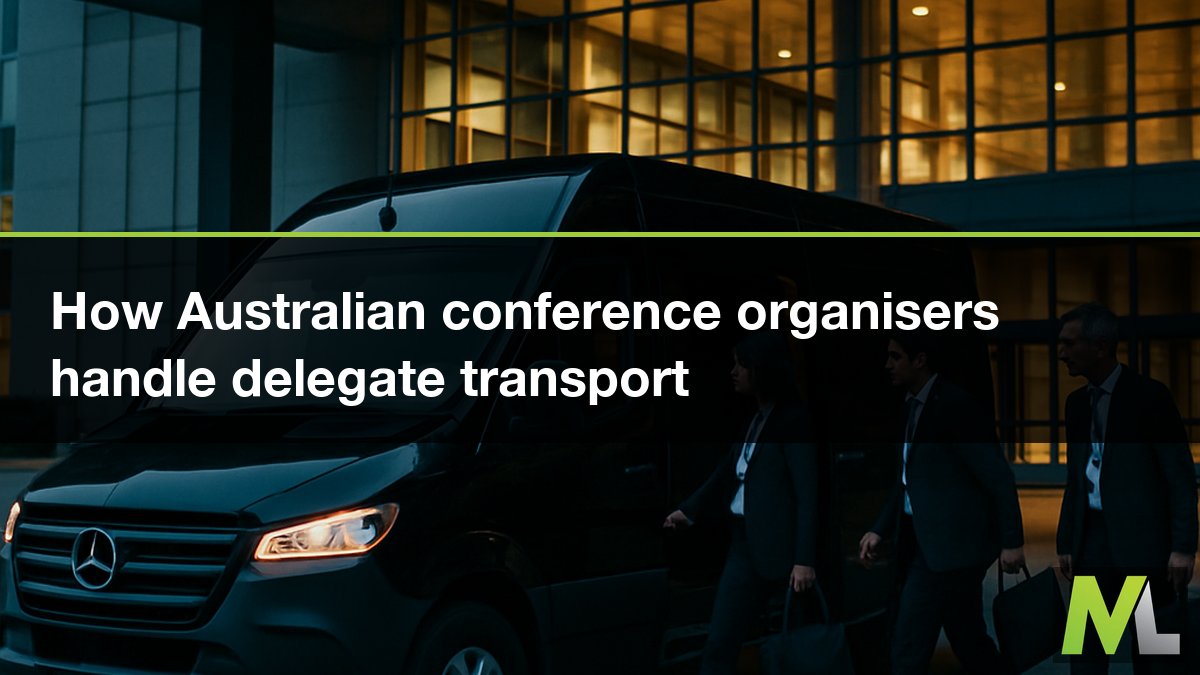
The vehicle mix for conference transport typically combines sedans for individual executives, Mercedes V-Class people-movers for small groups, and larger Sprinter-format vehicles for delegate cohorts, all from a single black fleet to maintain a consistent visual standard across the event. Conference organisers who have previously used mixed fleets, some branded, some unbranded, some contracted last-minute, often comment that visual consistency signals professionalism to delegates in a way that matters to the event’s overall impression. Arriving in a black Mercedes sedan versus an unmarked white minibus is not a trivial difference from the delegate’s perspective.
How are evening transfers to dinners and off-site events managed?
Off-site event transfers, including conference dinners, gala events, and post-session networking functions, require a separate vehicle schedule that accounts for a staggered departure from the venue and a return window that may extend to midnight or beyond. Delegates leaving a conference dinner in groups over a 90-minute window need vehicles staged outside the venue ready to collect, not vehicles that are called on demand and arrive 20 minutes late. For event chauffeur bookings in Sydney, staging vehicles in the correct holding area outside a venue like the Sydney Town Hall or the ICC Sydney requires advance coordination with event staff.
What is the lead time for booking conference transport?
For large conferences, over 100 delegates requiring coordinated transport, a minimum of four to six weeks’ lead time is recommended; for smaller events with VIP transfers only, one to two weeks is typically sufficient. The longer lead time for large events is driven by vehicle scheduling, driver allocation, and the logistics brief preparation rather than pure availability. Transport providers who receive a brief with two weeks’ notice for a 200-delegate event are working from a position of constraint; those with six weeks’ notice can prepare properly.
Can the same operator handle transport across multiple Australian cities?
A single-operator arrangement across multiple Australian cities simplifies the conference organiser’s logistics considerably, one brief, one account, one point of contact, consistent service standards in each market. Marquee Limousines covers all major Australian cities, operating its own fleet in Sydney, Melbourne, and Adelaide, and coordinating through established partner operators in Brisbane, Perth, Gold Coast, and Canberra. For conference organisers managing events that move between cities in the same week, the alternative, separately briefing a different local operator in each city, multiplies communication overhead and inconsistency risk.
How should conference transport be billed for corporate accounts?
Corporate account billing for conference transport can be structured as a single consolidated invoice covering all vehicles across the event, which simplifies the reconciliation process for the event’s finance team compared to receiving separate invoices for each individual transfer. Account invoicing is available on a weekly or monthly cycle for approved clients. For conference budgets that require itemised reporting by delegate or by vehicle, the invoice format can be structured to match those requirements. Fixed-price quotes for all transfers mean there are no post-event surprises in the final account.
To discuss conference delegate transport logistics for an upcoming event, call Marquee Limousines on 1300 846 008.
Why do corporate clients choose Marquee Limousines?
Marquee Limousines provides pricing confirmed at booking, account invoicing for approved clients, and 24/7 operations across 8 Australian cities, the consistency that corporate travel managers require. Every booking is confirmed the evening before with an SMS containing the chauffeur’s direct contact number. The fleet is standardised in black executive vehicles, BMW 7 Series, Mercedes S-Class, Audi Q7, and Mercedes V-Class, maintaining a consistent presentation whether the booking is in Sydney, Melbourne, or Adelaide. Chauffeurs arrive 10 minutes before the scheduled pickup, and complimentary wait times are built into every airport transfer. Call 1300 846 008 or request a quote online to organise your corporate transport with Marquee Limousines.